
One Comic, a Dozen Covers: Collecting Variants in Canada
How the same comic ends up with a four-dollar cover and a two-hundred-dollar cover.
How can two copies of the same comic sit side by side, one worth pocket change, the other worth chasing across the country? Same script, same interior art, same staples. All that changed was the drawing on the front, and how few of that drawing Marvel let exist.
That is the rabbit hole we spend our weekends in. Below we break down what makes a cover a variant, why one sells for a fortune while its twin sits in a dollar bin, and how we get the good ones from up here in Canada. New Mutants #23 and Black Panther #25, both from 2021, keep coming up, so we lean on them to show the machinery.
What Makes a Cover a “Variant”
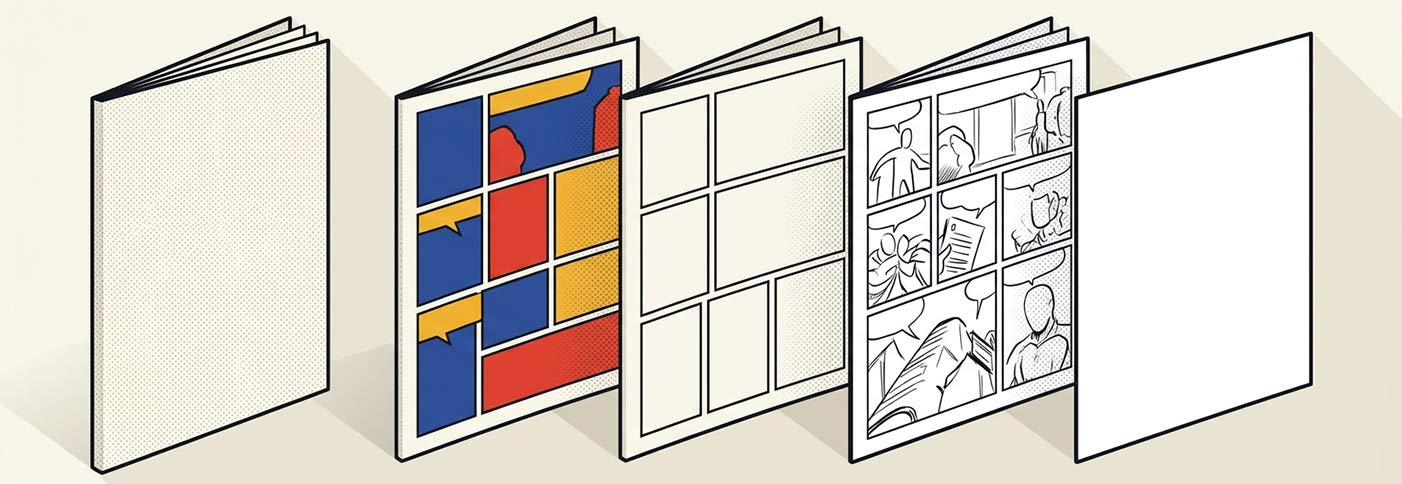
The standard cover, usually called Cover A, carries the full trade dress: the logo, the title, the price, and the barcode. A variant is any alternate cover a publisher prints for the same interior. Some variants are open to every shop. Others are gated behind order minimums, sold through a single store, or handed out only at events.
Publishers have printed alternate covers since the multiple-cover selling tactics of the early 1990s. The practice cooled, then returned in force through the 2010s, and it now shapes how new issues get ordered and priced.
The 1990s set the template. X-Men #1 shipped in 1991 with several interlocking covers and sold in the millions, which showed publishers that a second or third cover could drive orders on its own. The speculator crash that followed cooled the tactic for years. The modern ratio system brought it back with much tighter print runs, so scarcity now does the work that raw hype used to.
Trade, Virgin, Sketch, and Blank Covers
A handful of terms come up constantly. Knowing them makes a listing far easier to read.
| Cover type | What it is | Where it shows up |
|---|---|---|
| Trade dress (Cover A) | Full logo, title, price, and barcode | The default copy on the shelf |
| Virgin | The same art with logo and text removed | Ratio variants and store exclusives |
| Sketch / line art | Black and white or uninked version of the art | Collector piece, often used for signatures |
| Blank | A plain white cover | Sold for sketch commissions at conventions |
How Incentive Ratios Keep Covers Scarce
Marvel and DC gate many covers behind order ratios. A 1:25 means a shop has to order 25 copies of the standard cover to qualify to buy one copy of that variant. A 1:50 or 1:100 raises the bar. The higher the ratio, the fewer copies reach the market, and the more a single copy tends to cost.
Retailers carry the risk in this system. To claim one 1:100 variant, a store commits to a hundred regular copies it still has to sell. That math is why high ratio covers stay rare and why they hold a premium once they sell out.
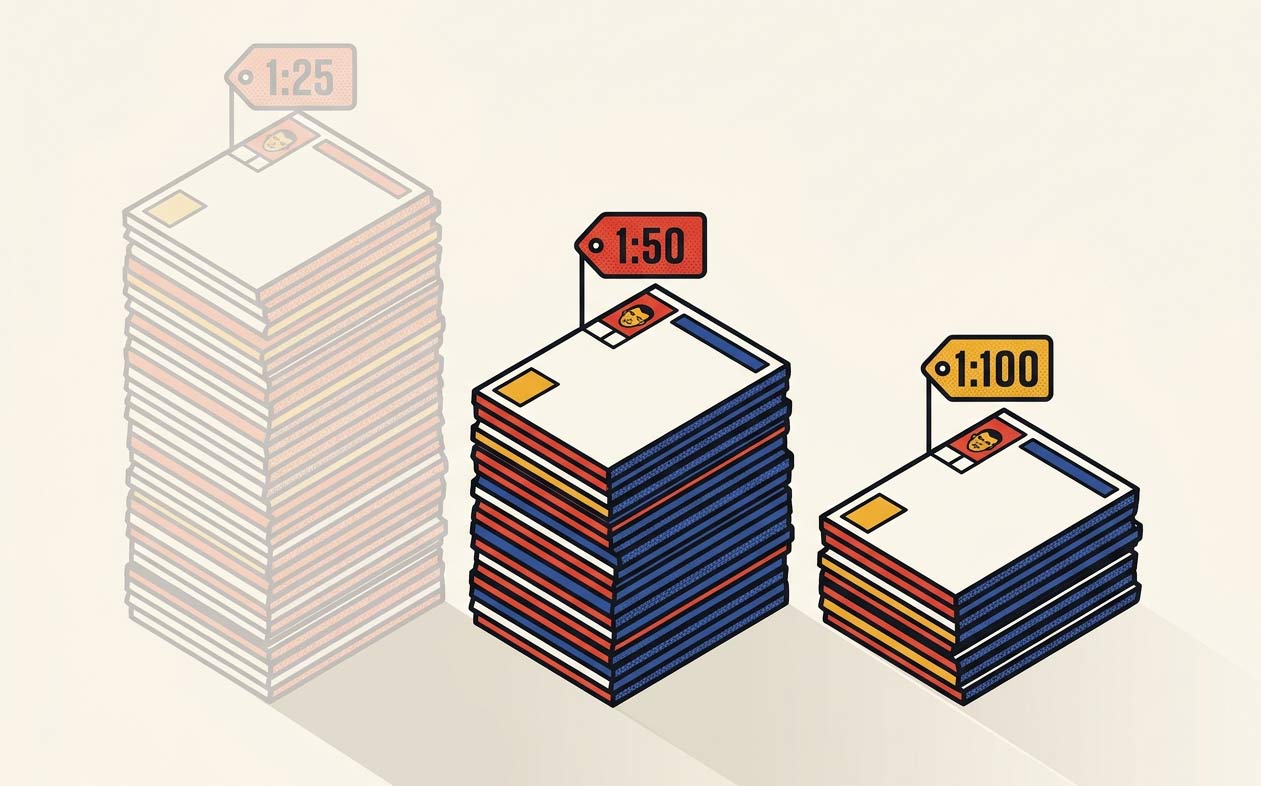
Not every alternate cover is gated this way. Publishers also print open order variants that any shop can buy in any quantity, and those stay cheap because supply simply follows demand. The premium lives with the ratio covers, where the publisher, not the shop, caps how many copies can exist.
| Ratio | Regular copies ordered per variant | What it usually signals |
|---|---|---|
| 1:25 | 25 | Fairly available, a modest premium |
| 1:50 | 50 | Scarcer, driven by artist or character demand |
| 1:100 | 100 | Low print run, strong secondary premium |
| 1:200 and up | 200 or more | Rare, usually a marquee artist or a key issue |
Store Exclusives and Shop-commissioned Art
Beyond publisher ratio variants, individual shops pay artists to draw covers that only that store sells. These retailer exclusives come in trade and virgin editions, often in a stated print run, sometimes with a certificate of authenticity. Because one store controls the supply, scarcity is set from the first day on sale.
Shops in Canada took part the same way American stores did. They ordered exclusive covers, split them into trade and virgin editions, and sold them through their own websites, eBay, and live selling apps such as Whatnot. For anyone getting into comic book collecting in Canada, store exclusives are often the first “chase” covers they run across.
Many exclusives are revealed at the Final Order Cutoff and capped at a set number, often a few hundred to a thousand copies. Stores frequently sell the trade and virgin editions as a pair, which is why the two turn up bundled in listings and why a virgin copy on its own can command more later.
Why One Cover Costs More Than Another
Several forces stack on top of each other. Scarcity comes first, set by the ratio or the print run. The artist matters next, since a name collectors follow moves copies on its own. The book itself carries weight: first appearances, final issues, and anything tied to film or television news pull in speculators. Condition closes the gap, because a graded slab sells for a multiple of a raw reading copy.
| Price driver | Why it moves the number |
|---|---|
| Print run or ratio | Fewer copies means more buyers per copy |
| Artist | A followed name lifts demand by itself |
| Key issue status | First appearances and finales draw speculators |
| Condition and grading | A CGC 9.8 slab sells well above a raw copy |
| Character heat | Movie and show news moves prices fast, up or down |
New Mutants #23 and the Reign of X Era
New Mutants #23, from the 2019 series, went on sale on December 1, 2021, at a $3.99 cover price. Vita Ayala wrote it, Rod Reis drew it, and Martin Simmonds handled the main cover, per Marvel and League of Comic Geeks. The issue closed the Shadow King arc and sat inside the Reign of X publishing era.
Buyers tend to search it as new mutants 23 2021 because it shipped late that year with a February 2022 cover date, and the Ayala run built a steady following. Its covers include the Simmonds trade edition and a textless version of the same art, which is the kind of clean image collectors look for.
Reign of X was the banner Marvel used for its X-Men line during the Krakoa era, so issues from that stretch get grouped together by collectors who follow the whole run rather than single issues. That context is part of why a mid-run issue still draws steady searches years later.
Black Panther #25 and Marvel’s Stormbreakers Covers
Black Panther #25 arrived on April 28, 2021, as an oversized final issue priced at $5.99. It closed Ta-Nehisi Coates’ five-year run, with interior art by Daniel Acuña and an epilogue by Brian Stelfreeze, according to GoCollect and Westfield Comics.
Marvel paired that finale with its Stormbreakers program, which spotlights a group of newer artists. For this issue Marvel released eight Stormbreakers “Fine Art” covers, by Natacha Bustos, Juann Cabal, Carmen Carnero, Joshua Cassara, Iban Coello, Patrick Gleason, Peach Momoko, and R.B. Silva, announced on February 19, 2021 (POC Culture, League of Comic Geeks). Gleason also had a separate webstore virgin variant.
The black panther 25 gleason search points straight at that Patrick Gleason Stormbreakers cover, one of the eight in the set.
Final issues pull in collectors because they close a defined run, and the oversized #25 carried extra pages for the send-off. That larger format is part of why its $5.99 price sat above the standard $3.99, and why the finale ended up with a deeper cover lineup than a regular issue would.
The Two Issues at a Glance
| Detail | New Mutants #23 | Black Panther #25 |
|---|---|---|
| Publisher | Marvel | Marvel |
| On sale | Dec 1, 2021 | Apr 28, 2021 |
| Writer | Vita Ayala | Ta-Nehisi Coates |
| Interior art | Rod Reis | Daniel Acuña, Stelfreeze epilogue |
| Cover price | $3.99 | $5.99 (oversized) |
| Notable covers | Simmonds trade, textless | 8 Stormbreakers, incl. Gleason |
| Why it gets searched | End of the Shadow King arc | Coates finale, Gleason cover |
Finding Variants Through Canadian Shops
Readers in Canada order variants the same way collectors elsewhere do, through the direct market. Local shops place their numbers weeks ahead against the Final Order Cutoff, the deadline when a store locks its order with the distributor. Ratio variants have to be claimed against that cutoff, so preordering through a shop is the dependable route rather than hoping a copy lands on the shelf.
Free Comic Book Day, held on the first Saturday of May, runs at participating Canadian stores and is a friendly on ramp for new collectors. The giveaway titles sit apart from ratio variants, but the day is a good way to meet a local shop that can handle preorders later.
Conventions add another channel. The Calgary Comic and Entertainment Expo and similar shows bring in dealers who carry variants and store exclusives, and some artists sign on site. After release, live selling on Whatnot and marketplaces like eBay is where most exclusives change hands.
Two practical notes shape what a Canadian buyer pays. Shops price in Canadian dollars and absorb the exchange rate and import costs, so the sticker often runs above the US number printed on the book. And collectors who want a copy sealed and graded send it to CGC, whose slabbed grades set much of the secondary pricing on the covers discussed above.
Questions Collectors Ask First
A. No. The interior is identical. Only the front cover art changes.
A. A shop orders 25 standard copies to qualify to buy one of that variant, which keeps it scarce.
A. The same cover art with the logo, title, and text removed, so the image runs clean.
A. No. Prices track demand, and demand shifts with character news and print run. Some settle back toward cover price.
A. Usually not. A high grade CGC slab sells for more than a raw copy of the same book.
About This Page
This is an independent reference about comic collecting and variant covers. The domain previously hosted Nerd Pharmaceuticals, a Calgary comic retailer that has since closed. That business is named here only for context. This page is not affiliated with it, and none of the issues discussed are offered for sale here. Prices and availability cited from third-party sources change over time.